
This was my test setup:
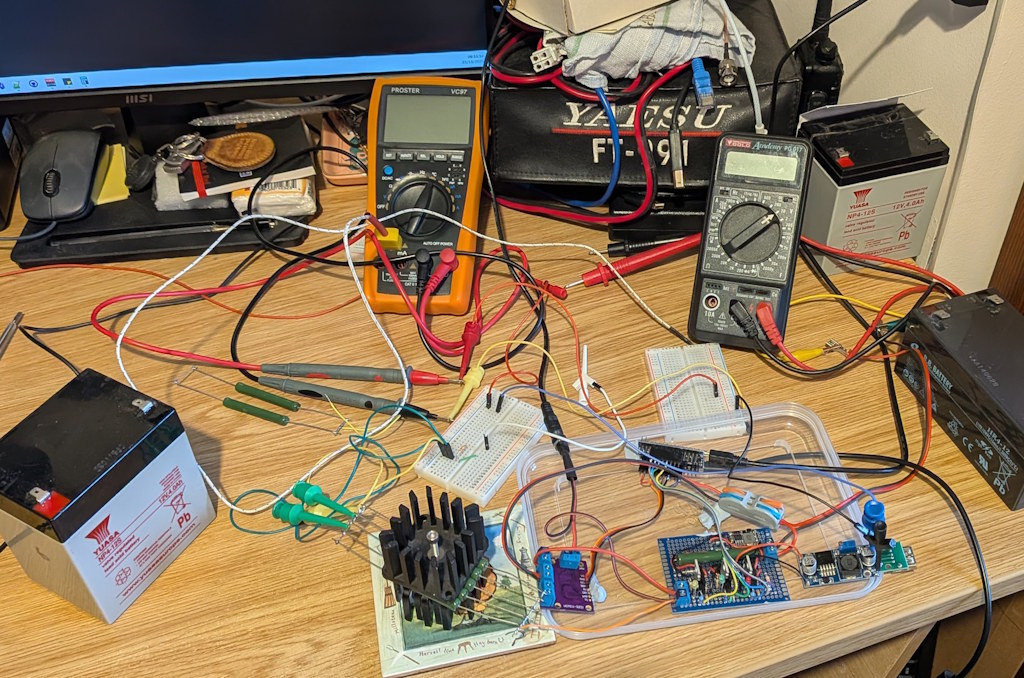
The only thing I wasn’t testing was the Raspberry Pi voltage. This left input voltage and current and battery voltage and current, from which I could work out things like efficiency and estimated run time.
I had 4 lead acid batteries that I got from a radio club junk sale. Three were 4Ah and one was 800mAh. I tried that first. Under load the voltage dropped considerably. It was clear that the battery had degraded, so I decided not to use it.
That left the three 4Ah batteries. The loads consisted of 13 ohm resistors in parallel. I made two types, one with five resistors:
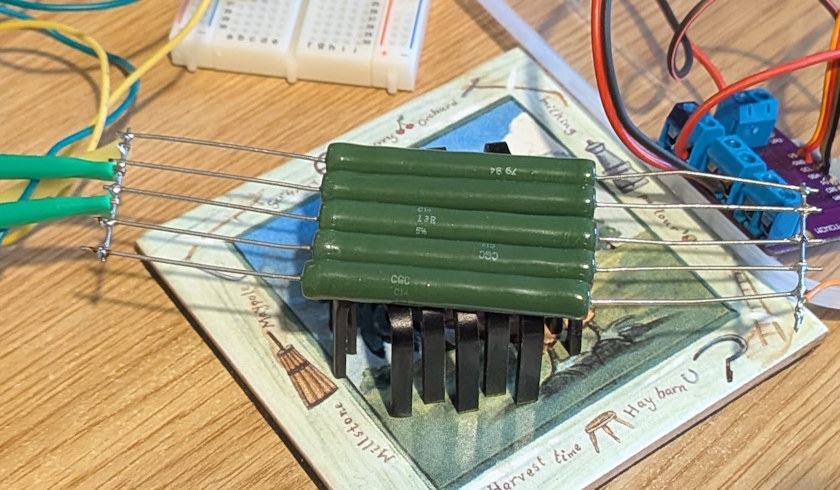
This gave a resistance of 2.6 ohms. The other was two resistors:
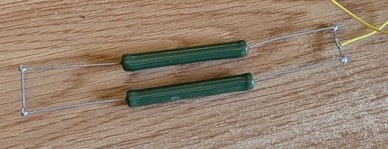
This gave a resistance of 6.5 ohms, which connected to 5.2V would draw a current of about 770mA.
| Input | Output | |
|---|---|---|
| Voltage (V) | 15 | 5.15 |
| Current (mA) | 746 | 1590 |
| Power (W) | 11.19 | 8.19 |
The current on the 5V side was slightly reduced due to the voltage drop across the ammeter. Dividing the output power by the input power gave an efficiency of 73%. The LM2596 case temperature (most of the 3W dissipation) was 78°C (ambient 23°C). When I increased the load current to 1.8A the temperature went up to 90°C. The documentation stated that there was a 6°C difference between junction temperature and case temperature (3W*2°C/W). The maximum junction temperature was stated as 150°C. The ambient temperature could easily be 20°C higher, so we are getting close to the safe limit. To be fair, the description on Aliexpress does say that 2A is the safe limit, and if running continuously above this a heatsink is recommended.
A quick internet search revealed that the LM2596 was probably not a genuine chip (Texas Instruments or National Semiconductor). The general consensus seemed to be that the “fake” ones were ok to use, but just not anywhere near the official 3A rating.
I measured the voltage drop across the supply MOSFET. This was 49.3mV which gives a 37mW power dissipation.
With a few changes to the software, I made it keep a running total of the current drawn (in mAh). I ran this for a few hours, and this is the data I collected:
| Time | Voltage | Current | mAh |
|---|---|---|---|
| 12:10:29 | 12.521 | 406.0 | 0.1 |
| 12:25:28 | 12.114 | 418.5 | 104.3 |
| 12:40:28 | 12.072 | 419.8 | 209.2 |
| 12:55:27 | 12.064 | 420.1 | 314.2 |
| 13:10:27 | 12.056 | 418.8 | 419.1 |
| 13:25:27 | 12.036 | 419.1 | 523.9 |
| 13:40:26 | 12.016 | 419.9 | 628.7 |
| 13:55:26 | 11.990 | 418.5 | 733.5 |
| 14:10:25 | 11.960 | 418.7 | 838.1 |
| 14:25:25 | 11.928 | 418.9 | 942.8 |
| 14:40:25 | 11.894 | 420.1 | 1047.7 |
| 14:55:24 | 11.856 | 420.9 | 1152.9 |
| 15:10:24 | 11.822 | 422.1 | 1258.6 |
| 15:25:23 | 11.784 | 423.2 | 1364.3 |
| 15:40:23 | 11.744 | 424.5 | 1470.1 |
At a C/10 discharge rate The battery should be capable of delivering 3Ah. I didn’t test this fully (deep discharge is very bad for lead acid batteries) but it does seem to hold quite a large capacity.